Quantum computing technology has been about to happen for decades, but the momentum has accelerated, with significant technology developments, emerging real-world applications, government funding and mandates for post quantum security. McKinsey estimates that quantum could create up to $2.7 trillion of economic value worldwide by 2035[1] and that quantum revenue could grow to $4.4 billion by 2028, having already reached a commercial tipping point.
What is quantum computing? what is the latest? and what should companies do?
Classical computers operate with bits which can be either 0 or 1, and the state of the bit is deterministic (known with certainty). Quantum computers operate with quantum bits, or qbits, which can be 0 or 1 at the same time (or a combination) and where states are superimposed with various levels of certainty until the state is measured, at which point they lose their quantum state. This makes quantum computers significantly faster (by many orders of magnitude) than classical computers at handling some tasks. Quantum computers are particularly suited for specific tasks that include optimization, simulations, machine learning and cryptography.
Here are a few highlights:
Error correction has crossed a threshold- Error correction is essential to most useful quantum computing applications. This can be enabled by linking hardware qubits together to form a logical qubit. These are genuine, error-corrected qubits capable of running algorithms below the fault-tolerance threshold[2]. It was recently demonstrated that adding more qubits reduces error rates rather than accumulating them. Logical qubits are now expected as early as 2028. “By 2028, we will bring Libra, a Megaquop-scale device, capable of executing one million quantum operations over hundreds of logical qubits, to our customers, enabling first scientific applications in quantum chemistry, high-energy physics, and materials simulation that are beyond the reach of classical and Noisy Intermediate-Scale Quantum (NISQ) computers today,” Amazon’s statement said.[3]
Government investment - The U.S. government is investing $2 billion through the CHIPS and Science Act across nine quantum computing companies. But the US is not the only one, and in fact, one could argue that that the US is a relative laggard in this regard. China has committed $15 billion, the EU over $10 billion, the UK £2 billion.
Recent tests showed the ability to send quantum signals along traditional traffic over common fiber links over a distance greater than 15 miles in Chicago.
Real applications are emerging - some examples
- AT&T is using D-Wave, a quantum vendor, for network optimization and announced the expansion of the agreement. D-wave cut the processing time for a network optimization workload from about one hour to under 15 seconds. AT&T now intends to evaluate the technology across additional use cases, including outage detection and response, technician routing, network build planning, and traffic management[4].
- In May 2026, IBM, Cleveland Clinic and RIKEN simulated the electronic structure of a 12,635-atom protein-ligand complex. That's a 40x increase in system size and a 210x improvement in accuracy vs. prior quantum workflow
- Goldman Sachs, JPMorgan, and BBVA have all run documented quantum pilots in portfolio optimization and Monte Carlo risk simulations.
But quantum technology has a dark side; in the wrong hands, it can break the encryption mechanisms underpinning current security infrastructures. The day this happens is called Q-Day, and people refer to Y2Q, or years to quantum, much like the industry coined Y2K decades ago.
Quantum computers can factorize large numbers, used in encryption, in mere minutes or seconds. This means that public-key cryptographic algorithms, upon which much of the security of today’s internet rests, could be rendered ineffective, and digital signatures can be compromised. Crypto is particularly at risk because quantum breaks the cryptographic underpinnings that secure cryptocurrency transactions and wallets.
Q-Day, or quantum day, is the day when quantum computers can break cryptographic algorithms. While no one knows when Q-Day is, people estimate it could happen within 3 - 10 years. In fact, the number of qubits needed to break RSA-2048 has been shrinking considerably, bringing Q-Day ever closer. Furthermore:
- The technology does not have to be mature and widely available for Q-Day to happen as early hacking is likely to be done by major state actors
- We may not know that a breach has happened for some time
- "Harvest now, decrypt later" attacks may be already happening. This is when bad actors collect the data and wait for the decrypting technology to become available.
Governments, and many companies have taken note. Regulation has been introduced in many countries to ensure PQC readiness. Here is a helpful summary chart, courtesy of Telefonica:
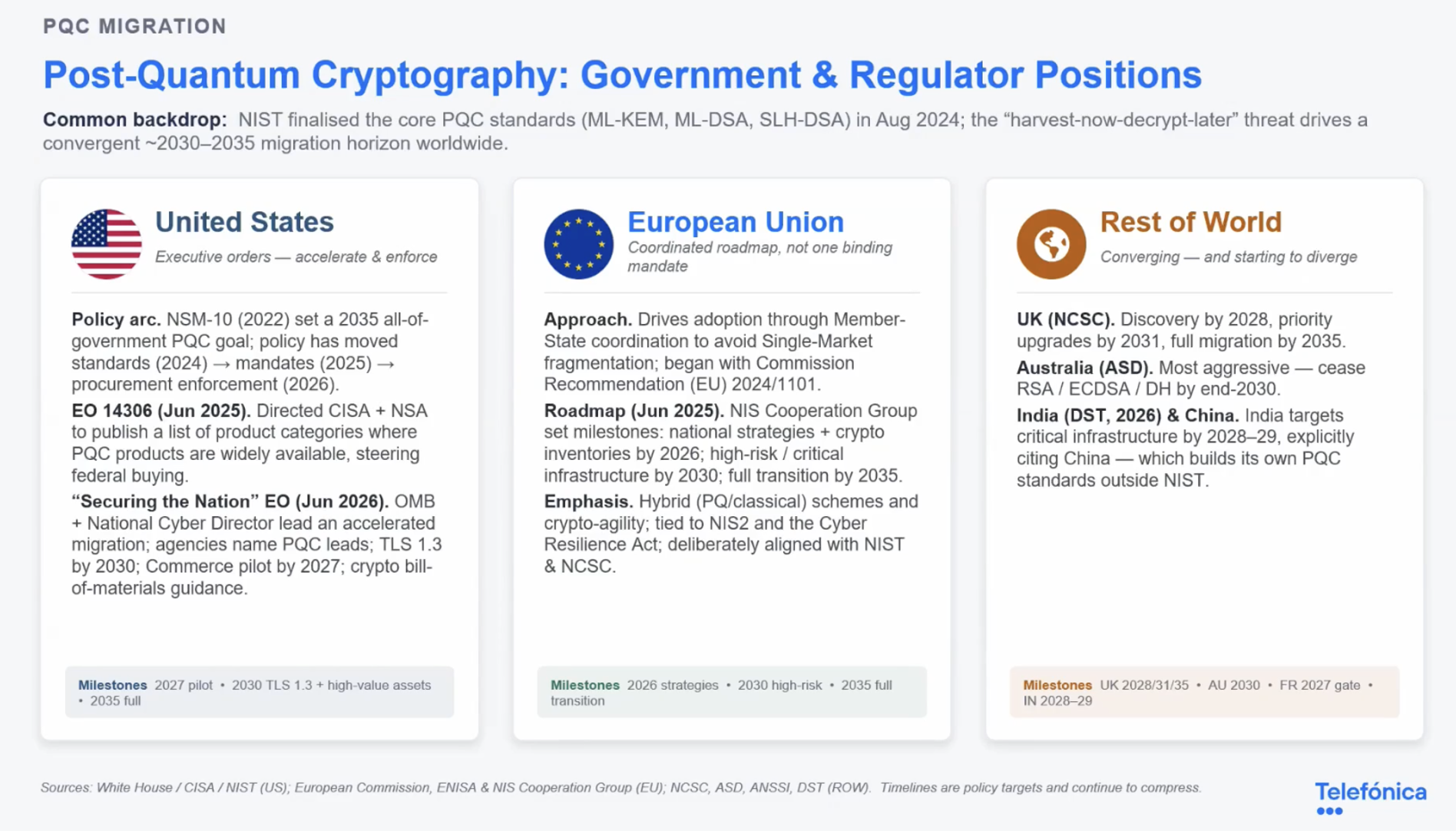
Figure 1 Source Telefonica
There are broadly two approaches to post quantum security:
Post Quantum Cryptography (PQC) replaces or supplements existing cryptographic systems with algorithms difficult to solve even with quantum computers. It is a software solution, similar to technologies used today, but requires longer security keys that require more processing, which some systems may not support.
Quantum Key Distribution (QKD) where a secret cryptographic key is shared between two remote parties. If it is intercepted, parties will know. This approach is not vulnerable to quantum attacks but requires new communication mechanisms for exchanging the keys. These mechanisms are in development. Currently quantum keys can be distributed over fiber over a distance up to 100 miles (with ongoing work to extend that), or via satellite.
In the near term, most focus is on PQC.
The key to protecting the enterprise is to start now. According to Deloitte, "Given the embeddedness of cryptography throughout the enterprise, the transition will likely be costly and time-intensive, with the potential to pose substantial interoperability issues[6]”.
Telecommunication companies are taking major steps to secure their infrastructure. Here is an example, courtesy of Telefonica:
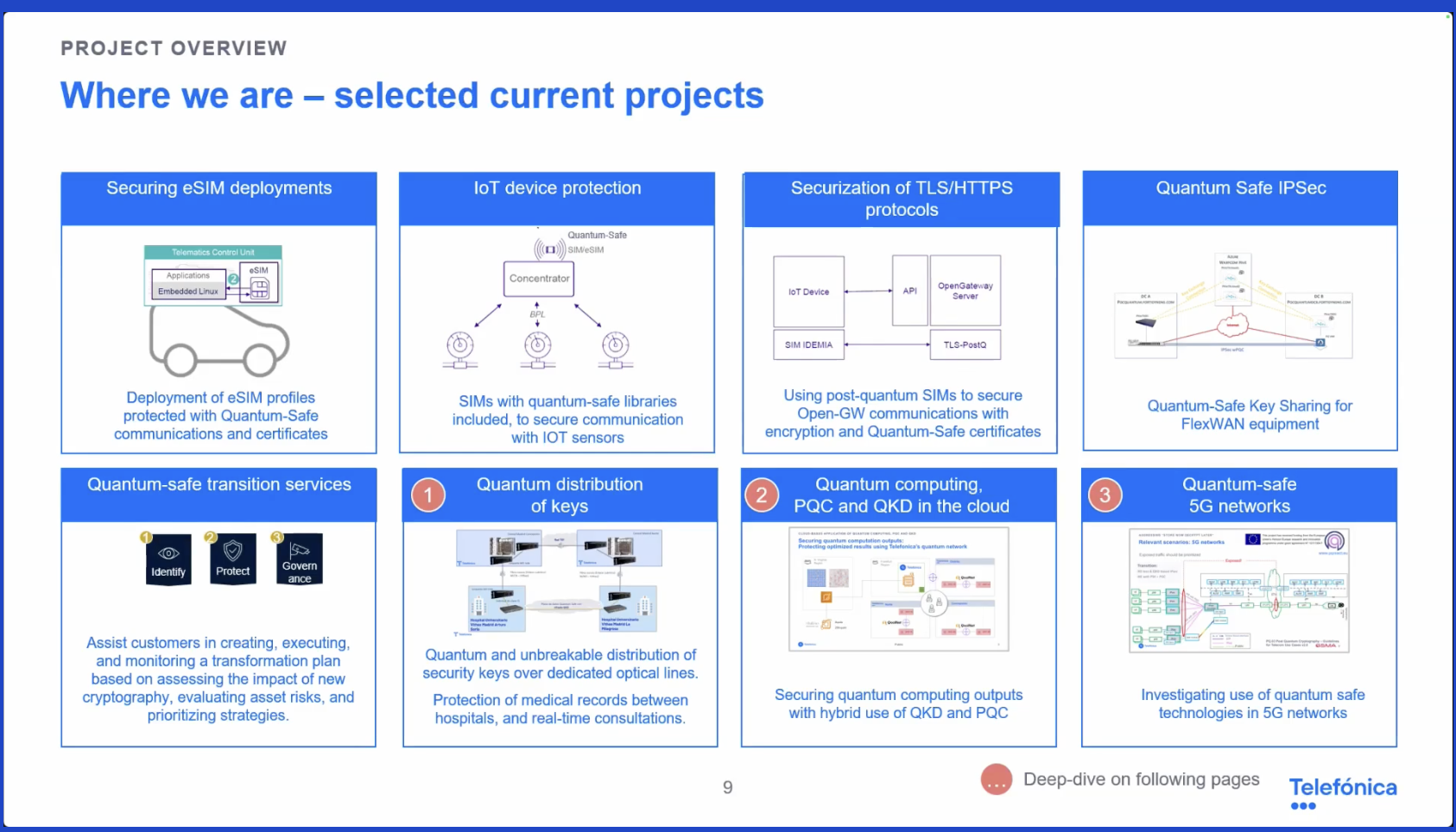
Figure 2 Source: Telefonica
Financial services firms have made massive investments to protect their systems. Some telcos such as Orange have started offering quantum security as a service to their business customers.
- Audit data assets to inventory all current encryptions and digital signatures
- Identify the data assets that need to be protected. Data with a short shelf life do not need to be protected.
- Adopt "quantum agility". This is the ability to quickly change or replace encryption algorithms and protocols without disrupting operations. This is important because quantum security is fast changing.
- Create the right governance framework. Assign someone in charge and define clear responsibilities
- Provide training to IT department personnel on quantum security.
- Select the right vendors / partners and work closely with them.
- Secure the entire ecosystem, not only your own environment. A weak link will break the chain.
While companies need to mitigate the security threat, quantum also presents massive opportunities. Unlike AI which operates at the "language" level, quantum is purely computational and is best suited for applications that are very computationally intensive such as factorization, optimization, molecular discovery, drug development and financial simulations.
Companies need to start building their quantum capabilities, including creating an ecosystem of vendors and partners, governance, organization know how, data assets and so on. They need to start identifying use cases where a hybrid classical-quantum compute solution is optimal. Companies already building a competitive edge by leveraging quantum capabilities. As referenced earlier, many companies are already using the technology to solve important problems and create value. The time to act is now.
[1]https://www.mckinsey.com/capabilities/mckinsey-technology/our-insights/mckinsey-quantum-technology-monitor-2026-a-commercial-tipping-point
[2] https://entangledfuture.com/quantum-computing-2026/
[3] https://arstechnica.com/science/2026/06/amazon-quera-promise-useful-quantum-error-correction-by-2028/
[4] https://seekingalpha.com/news/4618631-d-wave-quantum-rises-as-att-expands-quantum-pact?utm_content=link-1&position=rta_news_sublogic_pretestlaunch_main_0_title&utm_source=seeking_alpha&utm_campaign=rta-stock-news&messageid=2900&mailingid=46746887&serial=46746887.6567&utm_term=46746887.6567&source=email_2900&utm_medium=email
[5] https://newsroom.ibm.com/2026-05-05-cleveland-clinic,-riken,-and-ibm-model-a-12,635-atom-protein-the-largest-known-to-be-simulated-with-quantum-computers
[6] https://deloitte.wsj.com/cio/postquantum-cryptography-6-steps-to-build-resilience-749a66ad?gaa_at=eafs&gaa_n=ASWzDAgc_rD4R8ewDXGLdtVqU1iZoQZjFDS2yZsY2qvjY-QrfcXa0XGskebn-8rJO0I%3D&gaa_ts=68a3b435&gaa_sig=oua4hcZvrG1qSvsGcN-uzbBQRKUZ58-pACcz9n-IvjR2nQNi2DvSzriFEI03cC4Yyk7O03hm_ekH7y1fD1t5Lw%3D%3D


